
How to Set Up a Backgammon Board (Step by Step)
The starting position, explained point by point. Get your board set up correctly in under a minute, whether it's your first game or you just forgot over the winter.
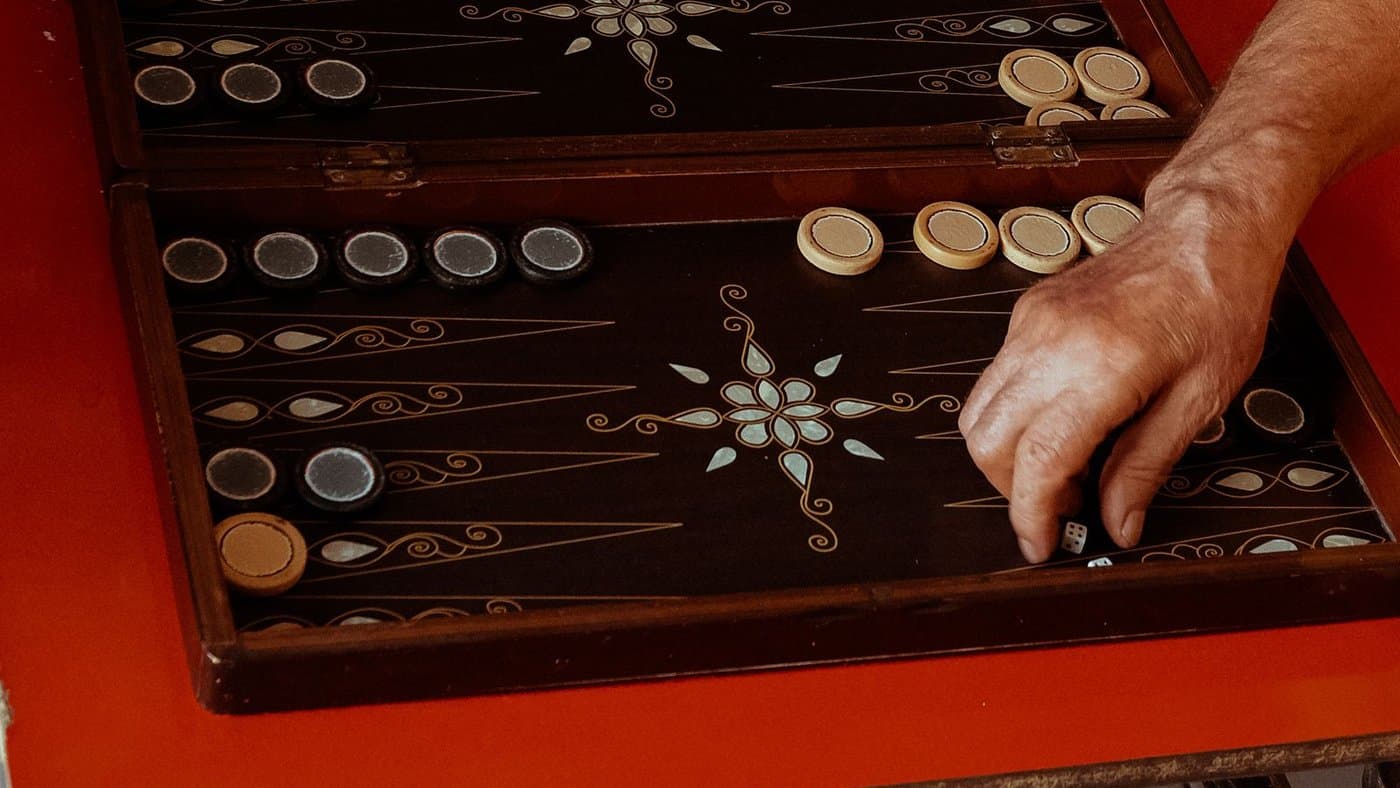
Every backgammon board looks the same once the checkers are down: two rows of triangles, a bar down the middle, and two little towers of discs facing off. Getting there from an empty board trips up more beginners than any rule in the actual game. Here's the setup, point by point.
The board itself
A backgammon board has 24 narrow triangles ("points"), 12 on each side, split into four groups of six by the bar in the middle and the outer edges of the board. Each player has a home board (the six points closest to them on one side) and an outer board (the six points further away). The two halves are mirror images of each other.
Points are traditionally numbered 1 through 24 from each player's own perspective — your 1-point is always in your home board, and your opponent's 1-point is your 24-point. This is why two people can look at the same physical board and describe a move using completely different numbers; both are correct, because the numbering is relative to the player.
Placing the checkers
Each player has 15 checkers, and every game starts from the identical arrangement (mirrored for each side). From your own perspective:
- 2 checkers on your 24-point (deep in your opponent's home board)
- 5 checkers on your 13-point (the far edge of your opponent's outer board)
- 3 checkers on your 8-point (the far edge of your own outer board)
- 5 checkers on your 6-point (the edge of your own home board, right next to the bar)
Do this for both colors and the board will look identical from either side of the table — each player sees their own back checkers deep in enemy territory and their own strongest point right at home.
Dice, cup, and doubling cube
Each player gets a pair of dice and (traditionally) a dice cup for shaking and rolling. Add the doubling cube — a six-sided die marked 2, 4, 8, 16, 32, 64 — placed on the bar or off to the side with the 64 face up, indicating the cube hasn't been used yet and either player is free to offer the first double. See the rules for exactly how the cube changes hands during a game.
Who goes first, and which way you move
Both players roll one die; whoever rolls higher moves first, using both of that opening roll's numbers (if the roll ties, both re-roll). From there, direction matters: one player moves from their 24-point toward their 1-point, the other moves the opposite way — the two players are always running toward each other's starting corner and away from their own. As long as both sides mirror the setup above from their own perspective, the directions sort themselves out automatically once you sit down and pick a side.
Quick sanity check
Before you roll, glance at both home boards. Each should have exactly 5 checkers on the 6-point and nothing else in the home board yet — if a home board looks crowded or empty in a way that doesn't match 2/5/3/5, something is misplaced. Fix it now; a single checker on the wrong point invalidates the whole game.
Once the position looks right, you're not learning backgammon anymore — you're playing it. That's the whole point of getting the setup memorized: it should take ten seconds and zero thought, every single time.