
Backgammon vs. Chess: What's Actually Different
Both are ancient two-player board games with a serious competitive scene — but they reward almost opposite skills. Here's how they really compare.
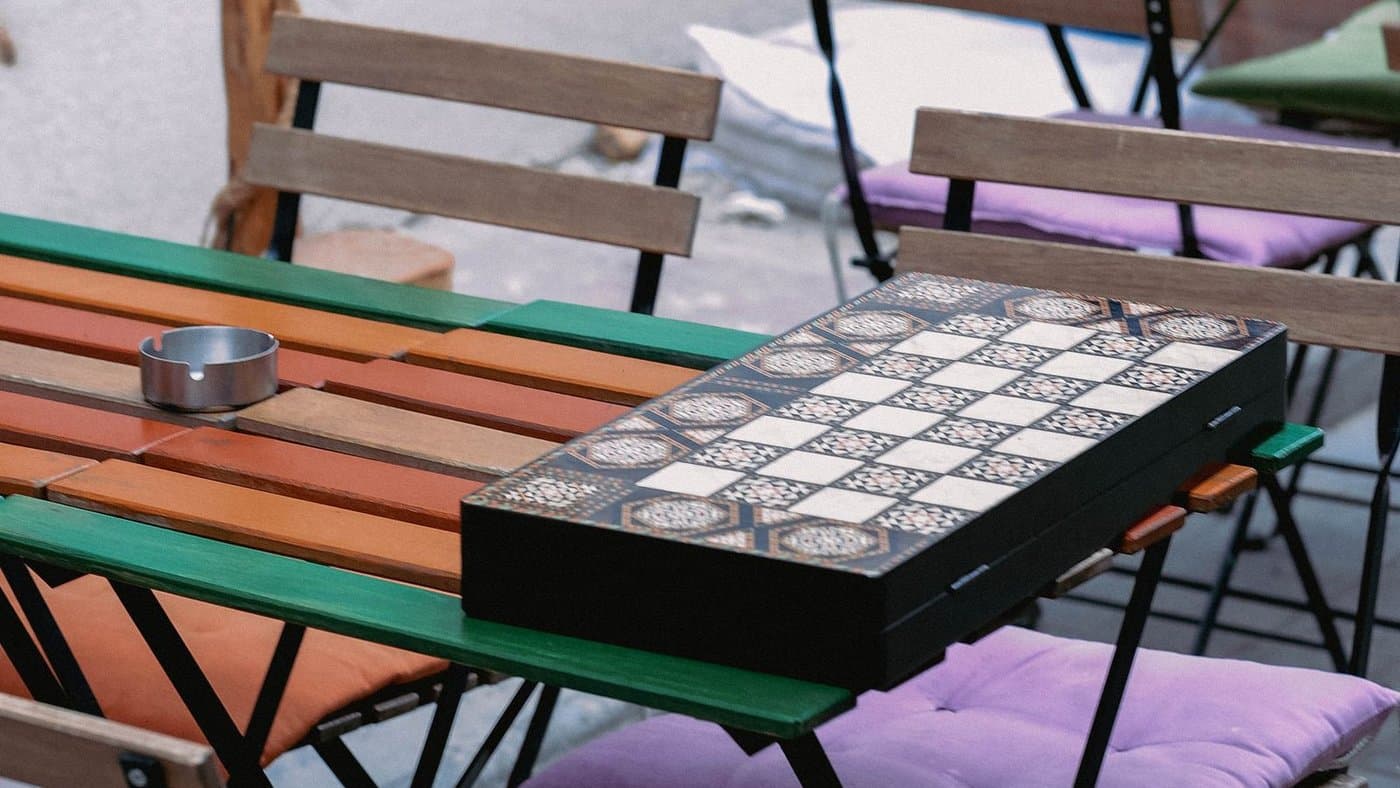
Ask someone to name a classic two-player board game and you'll usually hear chess first, backgammon second. They get lumped together constantly — both are old, both are played on a board with opposing pieces, both have serious tournament scenes. Past that surface, they're built on almost opposite ideas.
Chess has no luck. Backgammon is built on it.
Chess is a perfect-information, deterministic game: every move is a choice, nothing is hidden, and nothing is random. If you lose, it's because somewhere along the line you made a weaker move than your opponent — full stop. Backgammon runs on dice. Even the strongest player in the world will lose plenty of individual games to a bad roll at the wrong moment. Skill in backgammon shows up over many games, not any single one — which is exactly why the doubling cube exists: it lets players wager more when they believe the odds favor them, turning a single lucky roll into a manageable risk rather than a coin-flip for the whole match.
Backgammon is much older
Chess, in something close to its modern form, is roughly 1,500 years old. Backgammon's lineage is closer to 5,000 years, tracing back through Persian nard and the Roman tabula to board games unearthed in Mesopotamia. Neither game has stood still that whole time, but backgammon has an unusually long, well-documented history of surviving cultural shifts, religious bans, and total reinvention. We wrote a full history of that here.
Different kinds of thinking
Chess rewards deep, exact calculation: reading forward several moves and committing to the objectively best line. Backgammon rewards probabilistic judgment: you're constantly weighing risk against reward under uncertainty — should you leave a blot with a 1-in-6 chance of being hit if it wins the position outright the other 5 times? That's a fundamentally different mental skill, closer to poker or risk management than to chess calculation, even though the board and pieces look similarly "classical."
Game length and pacing
A serious chess game can run for hours over a single match. A single backgammon game is fast — often ten to fifteen minutes — but competitive backgammon is played as a match to a target score across many games, with the cube raising the stakes as it goes. That structure means a backgammon match has swings and comebacks a single chess game rarely allows: a huge cube turn can erase what looked like a decisive lead.
So which should you play?
If you want a game where the better player wins essentially every time given enough preparation, and you enjoy long, exact calculation — chess delivers that purity. If you want a shorter, faster game with real risk, where a weaker player has a genuine chance to win any individual game (and a very real edge over a match if they understand the cube), backgammon is the better fit. Plenty of strong players enjoy both for exactly these opposite reasons — they're not really substitutes for each other.